What is MDF Board?
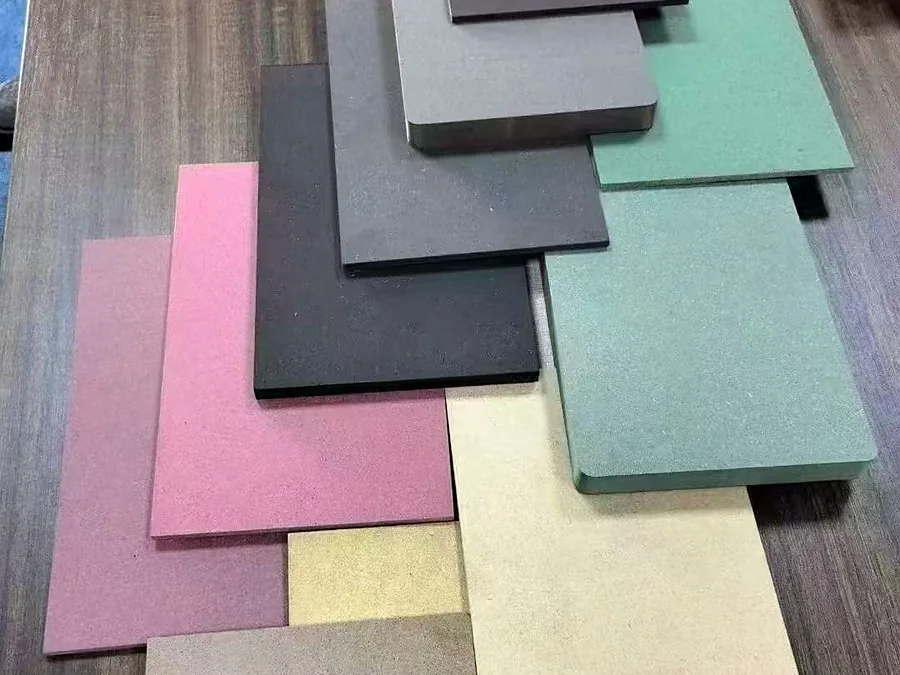
Medium-density fibreboard is made by breaking wood down into fibres, blending them with resin and pressing the mat under heat and pressure. The result has no grain, no knots and no voids: it machines, routers and profiles identically in every direction, which is why it dominates furniture fronts, door skins and moulded components.
We supply raw and sanded MDF in 2–30 mm with density of 680–760 kg/m³ and E1 formaldehyde emission. Panels are calibrated so thickness is consistent from sheet to sheet — the property that matters most when MDF is being edge-banded or laminated on an automated line.
Specifications
Standard production range. Sizes, glue types and grades outside this table can be produced to order — tell us the specification your customer requires.
| Panel size | 1220 × 2440 mm · 1830 × 2440 mm |
|---|---|
| Thickness | 2 / 3 / 4.5 / 6 / 9 / 12 / 15 / 18 / 25 / 30 mm |
| Density | 680 – 760 kg/m³ |
| Formaldehyde | E1 (EN 717-1) |
| Surface | Raw, sanded 120/150/180 grit |
| Internal bond | ≥ 0.60 MPa |
| Thickness swell | ≤ 12 % (24 h) |
| Machining | Routers, profiles and drills cleanly in all directions |
Why buyers choose our MDF Board
Density that holds a screw
Light MDF below 650 kg/m³ strips screws and crumbles at the edge. We hold 680–760 kg/m³, so hinges and cam fittings stay tight through assembly and transport.
No grain direction
Components can be nested on the sheet in any orientation, which reduces waste on CNC nesting by a meaningful margin compared with plywood.
E1 as standard
E1 (EN 717-1) emission on every batch, tested in our in-house laboratory. Test reports can accompany the shipping documents.
Thickness consistency for edge banding
Calibrated sheets band and laminate without thecrowning that shows up as a visible seam on a finished door.
Applications
Furniture fronts and carcasses
Doors, drawer fronts and painted carcasses.
Door skins and mouldings
Routing and profiling without grain tear-out.
Shop fitting and display
Painted and laminated display units.
Laser engraving and CNC work
Uniform density gives consistent engrave depth.
Wall panelling and acoustic panels
Perforated and slotted acoustic panels.
Packing & container loading
| Container | Volume | Details |
|---|---|---|
| 20GP | ≈ 20 m³ | Palletised, film wrapped |
| 40HQ | ≈ 28 m³ | 20–24 pallets, steel strapped |
| Note | Thin MDF (2–6 mm) | Supplied with protective top and bottom boards |
All shipments are palletised, steel strapped and wrapped in waterproof film. Loading photographs and a full document set are sent for every container.
Frequently asked questions
What is the difference between MDF and HDF?
Is MDF waterproof?
Can MDF be used outdoors?
What does E1 mean on an MDF datasheet?
Need a price for MDF Board?
Tell us the specification and destination port. Formal offer within 24 hours, samples available on request.